
"Digital transformation" has become a label for almost any technology project. That's exactly why so many transformation programmes stall: the budget gets spent, the slide deck gets updated, and the business works the same way it did before.
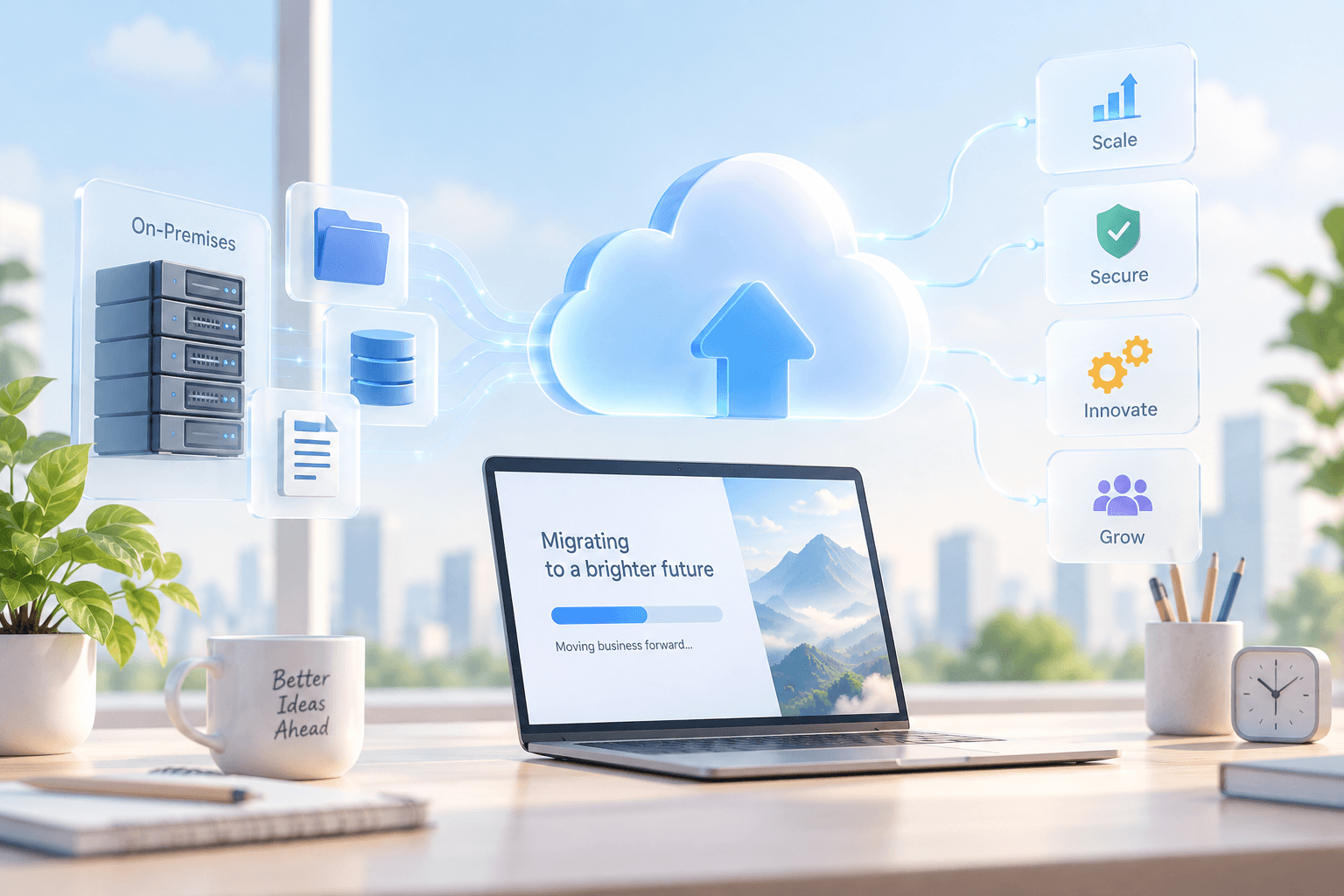
Cloud migration is different. Done well, it changes what your business can actually do: ship faster, scale on demand, and finally run the data, AI, and automation initiatives your leadership team keeps funding but can't get off the ground.
At JRC Software, we don't treat cloud migration as a one-off lift-and-shift that we run and walk away from. We treat it as the foundation of your wider transformation, and we architect it so it keeps paying off long after go-live.
What cloud migration actually involves
Cloud migration means moving applications, data, and infrastructure from on-premises systems, or from one cloud to another, onto a modern cloud platform. There's no single way to do it. The right strategy depends on each workload's age, value, and how fast it needs to change.
| Strategy | What it means | Best for | Trade-off |
|---|---|---|---|
| Lift and shift (rehost) | Move systems as they are, with minimal changes | Stable systems you need off old hardware quickly | Fastest, but carries existing inefficiencies into the cloud |
| Re-platform | Make targeted changes to use managed cloud services, such as a managed database | Apps that are sound but costly to run | Moderate effort for meaningful savings |
| Re-architect (refactor) | Redesign the system to be cloud-native | Core, fast-evolving systems that hold the business back | Highest effort; unlocks the most scalability and cost efficiency |
| Replace | Swap a system for a SaaS or off-the-shelf product | Commodity functions such as CRM, HR, or email | Less to maintain, but less control and some process change |
| Retain or retire | Keep a system where it is, or switch it off | Low-value or soon-to-be-replaced systems | Often the cheapest decision, and frequently overlooked |
The right approach depends on your business, not on which strategy sounds most modern. Most real migrations use several of these at once. Alongside these choices sits a separate decision about where workloads end up: a single cloud, several clouds, or a hybrid of cloud and on-premises, usually driven by regulatory, data-residency, or latency needs.
Why cloud migration is a business milestone, not just an IT project
Legacy infrastructure limits far more than your IT budget. It quietly holds the whole business back:
- Slower releases. New features wait on hardware, manual deployments, and change windows.
- Expensive scaling. Handling a seasonal peak or a new market means buying capacity you'll barely use the rest of the year.
- Blocked innovation. AI, advanced analytics, and automation need elastic compute and well-organised data that most on-premises estates can't provide.
That's why cloud migration is often the unglamorous prerequisite behind the transformation goals that get the headlines. We treat it as a business decision with a technical implementation, not a technical decision with a business case bolted on afterwards.
How we approach cloud migration: five steps
1. Assess before we architect. Every legacy environment hides dependencies, workarounds, and undocumented quirks. We start with a full audit of your systems, data flows, and integrations, because plans built on incomplete assumptions are where most overruns and outages begin.
2. Match the strategy to each workload. Not every system deserves the same treatment. A stable application with years of life left may be a good lift-and-shift candidate; a core system that limits the business today is usually worth re-architecting. We decide workload by workload, never with one blanket approach.
3. Build in security and compliance from day one. Moving data creates new risk surfaces, especially in regulated industries. We bring security and compliance specialists in at the planning stage, not after go-live to patch gaps.
4. Migrate in stages, with rollback plans. A big-bang cutover is high-risk and hard to recover from. We move in planned waves with clear rollback points, so any issue stays small and contained instead of becoming a business-wide incident.
5. Keep optimising after go-live. Cloud spend grows quietly when nobody is watching. We review usage after migration, right-sizing resources and cutting waste that's easy to miss once the project is "done."
Four reasons cloud migrations underdeliver (and how to avoid them)
Cloud migration has a reputation problem, mostly earned by projects that were rushed, under-planned, or treated as a checkbox.
| Pitfall | What happens | How to avoid it |
|---|---|---|
| Lift and shift with no follow-through | Old inefficiencies move to the cloud and simply cost more | Plan which workloads get re-platformed or re-architected after the initial move |
| No cost governance after go-live | The cloud bill balloons and the efficiency project becomes a budget problem | Assign ownership of cloud spend and review it on a regular schedule |
| Security added late | Compliance gaps found after migration cost far more to fix | Involve security and compliance in planning, before anything moves |
| No link to the bigger goal | The migration "works" but doesn’t enable the AI, data, or automation it was meant to support | Define the business outcomes first and design the target platform around them |
A technically successful migration that changes nothing for the business isn't a transformation. It's just a server move.
Why one integrated team makes the difference
Cloud migration touches almost every layer of your technology stack: infrastructure, security, data pipelines, application architecture, and the DevOps practices around deployment. When those are split across separate vendors, conflicts tend to surface halfway through the project, when they're most expensive to fix.
At JRC, cloud, platform, security, data, and cost expertise sit within one connected team. Your migration plan accounts for every dependency from the start, with one team accountable for the outcome.
Migration is a foundation, not a finish line
A successful cloud migration doesn't end at go-live. It builds the platform everything else depends on: scalable data pipelines, AI-ready infrastructure, and a cost structure that makes growth sustainable instead of expensive.
Done properly, cloud migration isn't just an IT upgrade. It's the groundwork that makes the rest of your transformation possible.
Planning a cloud migration? Let's talk. We'll help you work out what a well-scoped migration should deliver for your business, and tie it to the outcomes you actually want.
Planning a cloud migration and want it tied to a real transformation strategy, not just a server move?
Let's talk about what a well-scoped migration should actually deliver.