
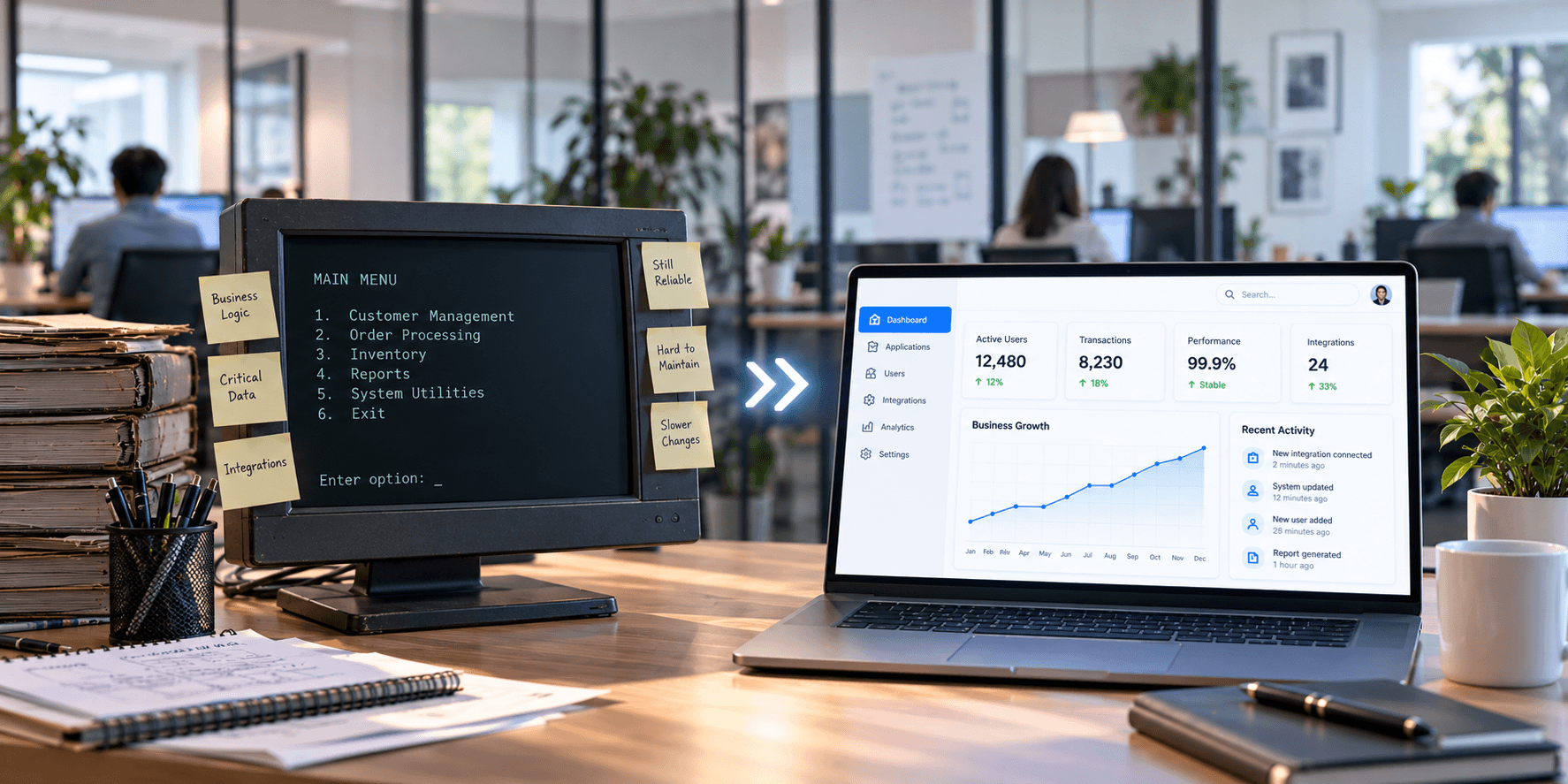
Legacy software rarely becomes a problem overnight.
It usually starts as a system that worked well for the business. Over time, requirements change, users expect more, integrations multiply, and technology moves forward. The system may still run reliably, but maintaining it becomes harder, changes take longer, and connecting it to modern platforms becomes increasingly difficult.
The answer isn't always to replace everything.
At JRC Software, we approach legacy modernisation as a business and technology transformation challenge. The goal is to improve what needs to change while protecting the systems, data, and processes that the business still depends on.
Start With Understanding, Not Replacement
The first step in modernising legacy software is understanding what you already have.
Which parts of the system are business-critical? Which components create the most operational risk? Where are the biggest maintenance challenges? What integrations and data dependencies exist?
A legacy system can contain years of business rules and operational knowledge that may not be fully documented anywhere else.
Replacing it without understanding those dependencies can introduce risks that are difficult to see until production.
Modernisation should therefore begin with assessment and discovery, not with a decision to rewrite everything.
Define What "Modern" Needs to Achieve
Modernisation isn't simply about moving an old application to a new technology stack.
The real question is what the business needs the system to do better.
That could mean:
- Faster development and releases
- Better user experiences
- Improved system performance
- Stronger security
- Easier integration with other platforms
- Better scalability
- More reliable data
- Support for new digital products or workflows
A clear target helps determine which parts of the system actually need to change.
Modernise in Manageable Steps
One of the biggest risks in legacy transformation is treating modernisation as a single, massive project.
A phased approach can reduce that risk.
Instead of replacing an entire system at once, teams can identify components that can be modernised independently, introduce new services alongside existing functionality, and gradually move capabilities to the new architecture.
This allows the business to continue operating while transformation progresses.
The right approach depends on the system, its dependencies, and the business objectives. In some cases, modernising selected components makes sense. In others, migration, re-platforming, or a larger redesign may be more appropriate.
Protect the Data and Business Logic
Legacy applications often contain more than code.
They may contain critical business rules, historical data, integrations, and workflows that have evolved over many years.
Modernisation therefore needs to consider how data moves between old and new systems, how business rules are preserved, and how existing integrations will continue to operate during transition.
This is where careful architecture and data engineering become particularly important.
Build for the Future, Not Just the Present
A modernised system should make future change easier, not simply solve today's technical problems.
That means considering scalability, maintainability, security, observability, integration, and deployment as part of the target architecture.
Cloud technologies, modern application architectures, APIs, automation, and data platforms can provide new options, but technology should follow the business requirement rather than drive the transformation by itself.
Keep Users Part of the Transformation
Technical modernisation is only one side of digital transformation.
Employees and customers still need to interact with the resulting systems.
A technically modern application can still create problems if the new experience is confusing or if established workflows are disrupted unnecessarily.
UX and Product Design can help ensure that modernisation improves the experience rather than simply changing the technology underneath it.
Understanding how people use the existing system can also reveal opportunities to simplify processes rather than reproducing outdated workflows in a new interface.
Security and Quality From the Start
Legacy modernisation can create new risks if security and quality are treated as final-stage activities.
As systems are migrated, integrated, or exposed through new interfaces, security requirements need to be considered alongside architecture and implementation.
Testing is equally important. Existing behaviour needs to be understood, critical workflows need to be validated, and new functionality needs to work reliably with the systems around it.
Modernisation Is a Journey, Not a Rewrite
There is no universal formula for modernising legacy software.
Some systems need incremental improvement. Others require significant architectural change. Some components may be worth replacing, while others may continue to serve the business effectively.
The objective is not to make technology newer for its own sake.
It is to create software that is easier to change, easier to integrate, more secure, and better aligned with where the business is going.
At JRC Software, digital transformation brings together capabilities across software engineering, UX and Product Design, AI, data engineering, cloud, platform engineering, quality engineering, and secure development.
That broader perspective matters because legacy modernisation is rarely just an engineering exercise.
It is about connecting technology decisions to business outcomes.
Modernise what holds the business back. Preserve what still creates value. Build what comes next.
Carrying legacy software that's holding the business back, but too risky to touch?
Let's talk about modernizing without disrupting what already works.