
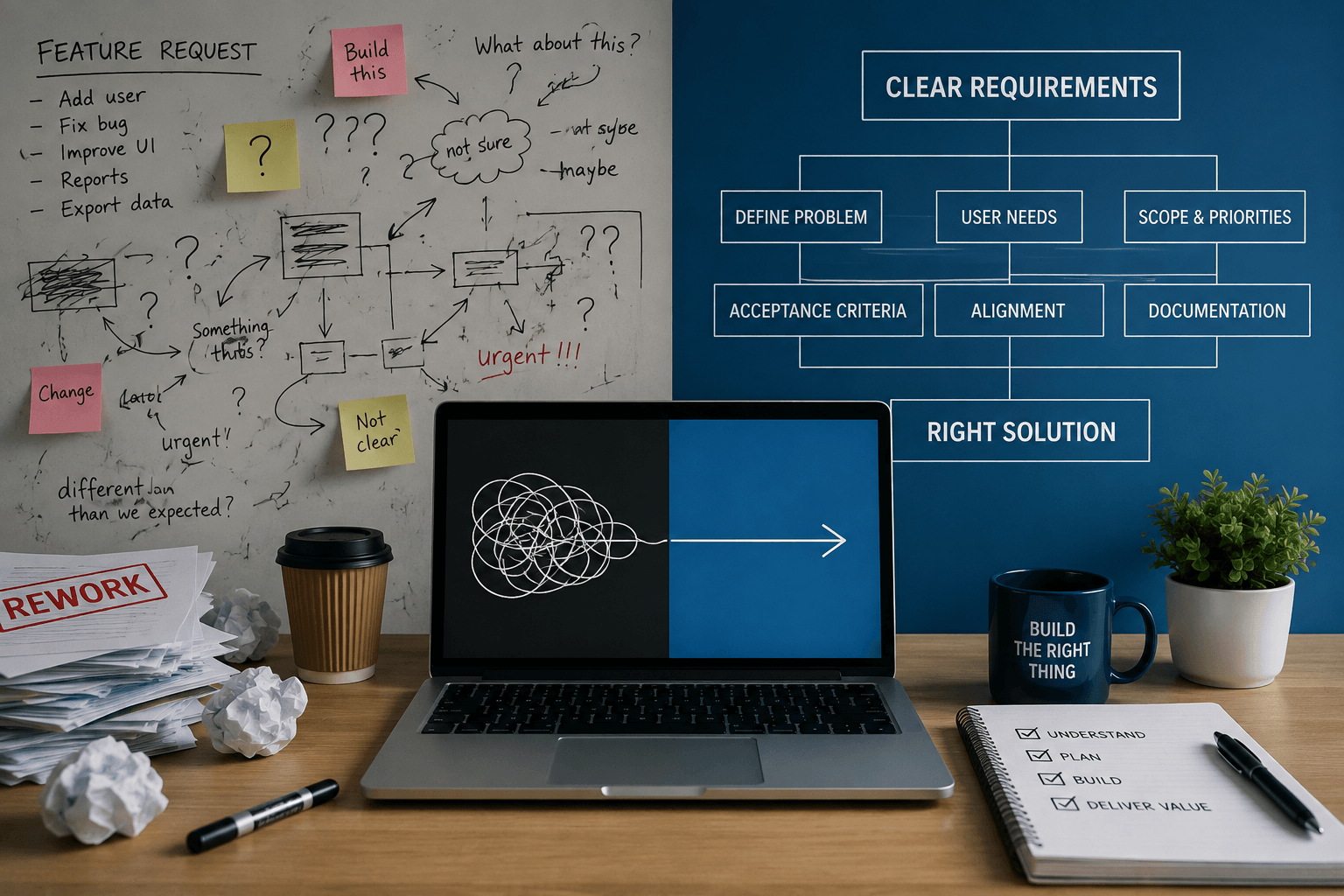
The biggest risk in software development isn't always writing the wrong code. It's building the wrong thing perfectly.
A feature can be implemented exactly as described in a ticket, pass every test, and still fail to solve the problem it was intended to address. Often, the problem starts with unclear requirements, assumptions, or missing details that surface only after significant time and money have been invested.
With AI coding assistants accelerating software development, this challenge has become even more important. Teams can generate code faster than ever, but faster implementation doesn't guarantee better outcomes. When requirements are ambiguous, AI can simply help build the wrong solution more quickly.
This is where spec-driven development makes a difference. At JRC Software, we believe successful software starts with a clear understanding of the problem, well-defined requirements, and a shared vision of what success looks like.
What Is Spec-Driven Development?
Spec-driven development is an approach that places a clear, structured specification at the centre of the software development lifecycle.
Instead of relying solely on brief tickets, informal discussions, or individual assumptions, the team establishes a shared reference that defines what the software should do, how it should behave, and how its success will be measured.
A good specification typically covers:
- Business objectives: The problem being solved and the expected outcome.
- Functional requirements: What the system must do, including important edge cases.
- Acceptance criteria: The conditions that determine whether a feature is complete.
- Technical constraints: Dependencies, integrations, security, performance, and reliability.
- Scope and exclusions: What is included and what falls outside the agreed requirements.
The goal isn't to document every detail. It's to remove ambiguity where it could affect the quality, cost, or outcome of the project.
Why Does It Matter More Today?
Modern software projects involve multiple disciplines, from product and design to engineering, QA, cloud, and security. Without a shared understanding, each team may interpret the same requirement differently, leading to delays and expensive rework.
AI-assisted development adds another dimension. AI tools can generate code, suggest implementations, and help create tests, but their effectiveness depends heavily on the context and instructions they receive.
Clear specifications give both developers and AI tools a better-defined target. They also help businesses evaluate progress against agreed outcomes rather than relying solely on completed tasks or subjective opinions.
How Spec-Driven Development Works
A practical spec-driven approach follows six key steps:
1. Understand the problem. Identify the business objective, intended users, existing challenges, and constraints before deciding on a solution.
2. Define testable requirements. Specify expected behaviour, inputs, outputs, edge cases, and measurable acceptance criteria.
3. Review before development. Bring relevant stakeholders together to identify gaps, resolve conflicting assumptions, and validate feasibility.
4. Build against the specification. Use the agreed requirements to guide architecture, implementation, code reviews, and AI-assisted development.
5. Validate the outcome. Test whether the software meets the requirements, not merely whether the code runs successfully.
6. Manage changes transparently. Update requirements and acceptance criteria when priorities or technical constraints change, keeping everyone aligned.
The level of detail should reflect the project's complexity and risk. A small feature may need only a concise specification, while a complex enterprise system requires more thorough planning.
The Business Value of Clear Specifications
Spec-driven development helps businesses reduce avoidable uncertainty throughout the software lifecycle.
| Without clear specifications | With clear specifications |
|---|---|
| Misunderstandings surface late. | Requirements are clarified early. |
| Teams work from different assumptions. | Everyone shares a common reference. |
| Testing focuses on whether the code works. | Testing checks whether requirements are met. |
| Changes create unexpected rework. | Changes are assessed against agreed requirements. |
| AI-generated code may miss the intended outcome. | AI-assisted development follows clearer instructions and constraints. |
Clear specifications cannot eliminate every defect or guarantee delivery within a fixed budget. However, they help teams identify gaps earlier, make better-informed decisions, and direct development effort towards the intended outcome.
Spec-Driven Doesn't Mean Rigid
A specification isn't paperwork for its own sake, nor should it prevent teams from adapting to change.
Projects evolve as business priorities shift, users provide feedback, and technical challenges emerge. A good specification makes those changes visible and helps teams understand their impact.
The principle is simple: document enough to make the right decisions, test the right outcomes, and adapt without losing alignment.
Build the Right Thing From the Start
Great software begins with more than good code. It starts with understanding the problem, defining clear requirements, and agreeing on what success means.
As AI continues to accelerate development, the ability to define the right solution becomes increasingly valuable. Spec-driven development helps teams bridge the gap between business ideas and reliable software, creating a stronger foundation for development, testing, and continuous improvement.
Because building software faster only matters when you're building the right software.
Planning a new software project or feature? At JRC Software, we help turn business ideas into clear, testable specifications that guide development towards meaningful results. Let's define the right solution before we build it.
Planning a project and want it built right the first time?
Let's talk about turning requirements into a working spec.